Free Wedding Ceremony: The Perfect Guide for Your Personalized Ceremony
A free wedding ceremony is a unique moment full of emotion, personality, and love. It gives you the freedom to design your wedding exactly as it suits you—without church or civil-registry requirements. But what does such a ceremony look like? What are the most important elements? And how do you make sure your guests remember this day forever?
As a wedding master of ceremonies, wedding celebrant, and independent officiant, I’ve been accompanying couples on their way to the perfect “I do” for years. In this guide, I share my experience and give you a clear but flexible schedule for your free wedding ceremony.
Free wedding ceremony schedule at a glance
If you’d like a quick overview, a typical free wedding ceremony often looks like this:
- Guests arrive and a calm settling-in
- Entrance of the couple or one partner
- Welcome and introduction
- Personal words and the wedding speech
- Reading, wedding quote, or a symbolic opening
- Vows or marriage promises
- Ring exchange
- Ritual or guest involvement
- Kiss, closing words, and a ceremonial wrap-up
- Exit, congratulations, and transition into the celebration
Of course, every ceremony is individual. That’s exactly what makes a free wedding ceremony so special: the schedule isn’t a rigid concept, but a framework we shape together so it truly fits you.
Planning starts before the wedding day
A successful free wedding ceremony doesn’t begin on the day itself, but in the preparation. The clearer we talk beforehand about your wishes, your story, and the atmosphere you want, the more personal and coherent the schedule will be.
1. The getting-to-know-you meeting
- We talk about you as a couple, your story, and your wishes.
- What mood do you want—emotional, relaxed, ceremonial, or with humor?
- We clarify which elements, people, or symbols should be included.
2. The planning meeting
- Now the exact schedule is set.
- We discuss texts, music, rituals, and possible contributions from guests.
- If you’d like, I can also support you with your vows or the ring moment.
3. The final check-in
- Shortly before the wedding, we go through everything together once more.
- Open questions are clarified so you can relax on the big day.
Tip: Even a beautiful schedule can stay flexible. Small spontaneous moments often make a free wedding ceremony even more personal.
How long does a free wedding ceremony last?
Many couples wonder how long a free wedding ceremony should ideally be. In practice, the ceremony often lasts between 30 and 60 minutes, depending on how many personal elements, rituals, or musical pieces are included.
- About 30 minutes: short, clear, and streamlined
- About 45 minutes: the most common and a very balanced framework
- About 60 minutes: ideal with multiple contributions, music, or more intensive rituals
What matters isn’t just the length, but that the ceremony feels complete and leaves enough room for real emotions.
The schedule of a free wedding ceremony step by step
Every free wedding ceremony is individual, but a few elements have proven themselves and create a well-rounded, emotional, and unforgettable ceremony.
1. Welcome and introduction
The ceremony begins with a warm welcome. Guests are greeted and attuned to the special moment. Often, this is the point where anticipation slowly turns into genuine emotional presence.
2. The personal wedding speech
The wedding speech is the heart of the ceremony. It tells your story—authentically, lovingly, and in a way you recognize yourselves in. Some couples want more lightness, others depth, many a mix of both.
3. Wedding quote, reading, or special words
Between the speech and the personal highlight, a wedding quote, a reading, or a short contribution from loved ones can be included. This adds extra depth and often creates a very connecting moment.
4. Vows and marriage promises
For many couples, this is the most emotional part of the free wedding ceremony. If you’d like to speak your own words, you can draw on personal memories, gratitude, and a promise for the future. You can also find help with writing in my post about individual vows.
5. Ring exchange
The ring exchange is a classic and highly symbolic moment. It can be paired with personal words, a short ritual, or a traditional promise.
6. Kiss and closing
At the end of the ceremony, there are usually closing words, the kiss, and the ceremonial exit. Afterwards, the mood often transitions naturally into congratulations, music, and the next part of your wedding day.
Music in the free wedding ceremony schedule
Music contributes enormously to the atmosphere and can make individual moments even more intense. Musical pieces are especially popular for the entrance, between sections, during the ring exchange, or for the exit.
Whether it’s live singing, an instrumental piece, or your very own song—what matters is that the music matches the character of your ceremony and doesn’t just “sound nice.”
Rituals as part of the schedule
Rituals can beautifully deepen a free wedding ceremony—if they truly fit you. Particularly popular are candle rituals, sand ceremonies, handfasting, or planting a tree.
If you’d like to learn more about the symbolic meaning, you can also find a post here about the meaning of the wedding candle.
My tip: It’s better to choose one ritual intentionally than to include several elements just for the sake of completeness.
Combining a free wedding ceremony and civil registry
Many couples decide to separate the legal and emotional sides of their wedding. The civil registry covers the official part—while the free wedding ceremony creates the personal framework.
Whether you plan both on the same day, want to celebrate the free ceremony after the civil registry, or wonder what’s possible without the civil registry: you’ll find more on this in my post about the free wedding ceremony in connection with the civil registry.
Schedule variants: small, intimate, or ceremonial
Not every free wedding ceremony has to be large. Some couples want a very intimate setting with just a few guests; others love the ceremonial character with music, multiple contributions, and a stronger dramatic build-up.
Both are possible—what matters is that the schedule fits your personality, your location, and your energy as a couple.
A free wedding ceremony on the beach or in the mountains?
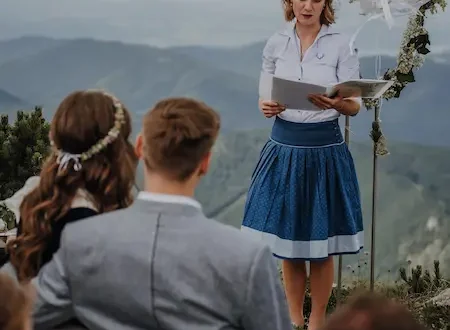
The location influences the schedule more than many think. A free wedding ceremony on the beach often thrives on lightness, openness, and a natural flow. In the mountains or at higher elevations, access routes, timing, temperature, and wind often play a bigger role.
That’s why I always plan the schedule with the surroundings in mind—so everything feels cohesive and you can focus fully on your moment.
A solid bad-weather plan is always part of it
Especially for outdoor free wedding ceremonies, a plan B is worth its weight in gold. Wind, rain, or intense heat don’t have to become a problem if the schedule has been thought through in advance.
A good schedule therefore considers not only the ideal scenario, but also alternatives—such as a sheltered area, adjusted timing, or small setup changes.
The perfect schedule is the one that fits you
A free wedding ceremony is especially beautiful when it doesn’t feel like a rigid program, but like a genuine expression of your relationship. The best schedule isn’t the most complicated—it’s the one that gives you room for real emotions, personality, and connection.
With experience, sensitivity, and a clear structure, I accompany you so your ceremony becomes light, cohesive, and unforgettable.
Frequently asked questions (FAQ) about the schedule of a free wedding ceremony
What is the typical schedule of a free wedding ceremony?
Most ceremonies begin with the entrance and a welcome. Then come personal words, the wedding speech, a quote or reading, the vows, the ring exchange, a possible ritual, and finally the closing with a kiss and exit.
How long does a free wedding ceremony usually last?
Most free wedding ceremonies last between 30 and 60 minutes. The exact timeframe depends on how many personal elements, musical pieces, or rituals are included.
When do vows happen in the schedule?
Vows or marriage promises usually come after the wedding speech and before the ring exchange. They are often the most emotional part of the ceremony.
Can you combine a free wedding ceremony and the civil registry?
Yes—many couples intentionally separate the legal part from the emotional one. The civil registry handles the official marriage, while the free wedding ceremony can be designed individually.
Which rituals fit into a free wedding ceremony?
Popular choices include candle rituals, sand ceremonies, handfasting, or personal symbolic actions. What matters is that the ritual truly fits you and your story.
What happens in bad weather?
A good bad-weather plan ensures your free wedding ceremony still feels cohesive. Often an alternative location, a small timing adjustment, or a sheltered area is enough.


5 Comments
Pingback:
Pingback:
Pingback:
Pingback:
Pingback: